
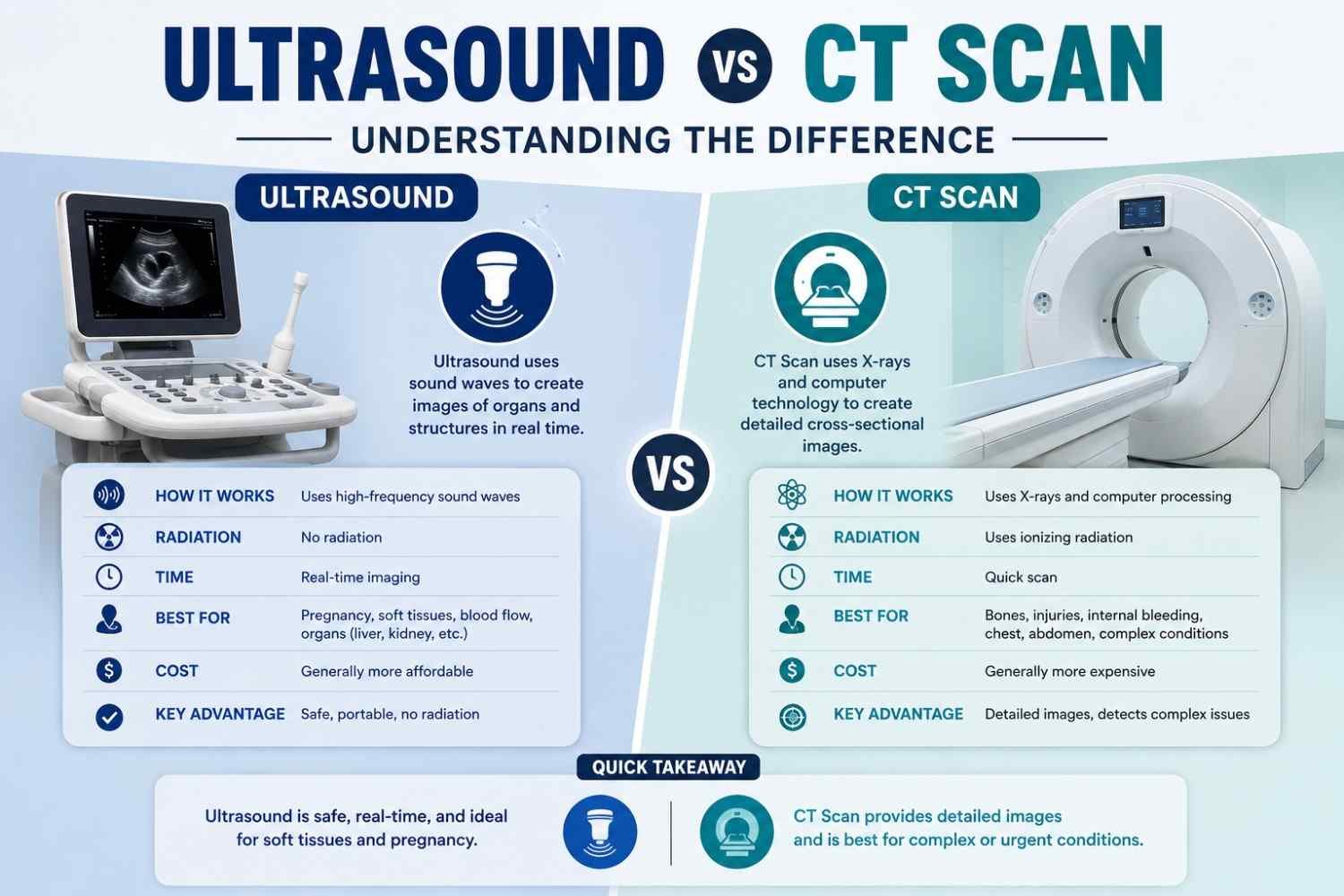
Ultrasound vs CT Scan: Understanding the Difference
OnePLUS Ultrasound Lab2026-06-15T09:17:36+00:00When doctors need a closer look inside the body, they often recommend imaging tests such as an ultrasound or a CT scan. Many patients are confused about which test is better and why one may be recommended over the other. Understanding the ultrasound vs CT scan comparison can help you make informed healthcare decisions and know what to expect during diagnosis.
Both imaging techniques are widely used in modern medicine, but they work differently and serve different purposes. In this guide, we will explain the Difference Between Ultrasound and CT Scan, their benefits, accuracy, and when each test is commonly used.
What Is an Ultrasound?
Ultrasound is a diagnostic imaging technique that uses high-frequency sound waves to create real-time images of organs, tissues, and blood flow inside the body. It is a safe, non-invasive procedure that does not use radiation.
Doctors often recommend an ultrasound for:
- Pregnancy monitoring
- Abdominal examinations
- Kidney and liver assessments
- Gallbladder evaluations
- Pelvic health checks
- Thyroid examinations
One of the major Benefits of Ultrasound Imaging is its safety, making it suitable for pregnant women and repeated follow-up examinations.
What Is a CT Scan?
A CT (Computed Tomography) scan uses X-rays combined with computer technology to produce detailed cross-sectional images of the body. These images provide a more comprehensive view of bones, organs, blood vessels, and soft tissues.
CT scans are commonly used for:
- Detecting tumors
- Diagnosing internal injuries
- Evaluating lung conditions
- Identifying fractures
- Assessing complex abdominal conditions
- Emergency trauma evaluations
Because CT scans provide highly detailed images, they are often preferred when doctors need a deeper understanding of a medical condition.
Difference Between Ultrasound and CT Scan
Understanding the Difference Between Ultrasound and CT Scan is essential when comparing these diagnostic tools.
|
Feature |
Ultrasound |
CT Scan |
|
Technology |
Sound waves |
X-rays |
|
Radiation Exposure |
No radiation |
Uses radiation |
|
Cost |
Generally lower |
Usually higher |
|
Procedure Time |
15–30 minutes |
10–20 minutes |
|
Pregnancy Safety |
Safe |
Usually avoided unless necessary |
|
Best For |
Soft tissues and pregnancy |
Detailed organ and bone imaging |
|
Portability |
Highly portable |
Fixed equipment |
This CT Scan and Ultrasound Comparison highlights that both tests have unique advantages depending on the medical situation.
Ultrasound vs CT Scan for Diagnosis
The discussion around Ultrasound vs CT Scan for Diagnosis often depends on the symptoms and body area being examined.
Ultrasound is particularly effective for:
- Gallstones
- Pregnancy assessments
- Liver conditions
- Kidney stones
- Thyroid disorders
- Blood flow evaluations
CT scans are more suitable for:
- Internal injuries
- Cancer detection
- Lung diseases
- Brain disorders
- Complex abdominal conditions
- Bone and spine injuries
Doctors select the imaging method based on the type of information required for an accurate diagnosis.
CT Scan vs Ultrasound Accuracy
When comparing CT Scan vs Ultrasound Accuracy, CT scans generally provide more detailed images of internal structures. They can detect smaller abnormalities and offer comprehensive cross-sectional views.
However, ultrasound remains highly accurate for specific applications such as:
- Pregnancy monitoring
- Gallbladder diseases
- Soft tissue assessments
- Blood vessel evaluations
The accuracy of either test depends on the condition being investigated and the expertise of the radiologist interpreting the results.
When to Choose Ultrasound Over CT Scan
Many patients wonder when to choose an ultrasound over a CT Scan. Ultrasound is often preferred when:
- Radiation exposure should be avoided
- A patient is pregnant
- Real-time imaging is required
- Initial evaluation of abdominal pain is needed
- Blood flow studies are necessary
- A cost-effective diagnostic option is preferred
In these situations, ultrasound can provide valuable diagnostic information without exposing the patient to radiation.
Advantages of CT Scan
Although ultrasound has many benefits, CT scans offer certain advantages:
- More detailed internal images
- Faster diagnosis in emergencies
- Better visualization of bones and lungs
- Improved detection of tumors and internal bleeding
- Comprehensive body assessments
These benefits make CT scans a critical tool in emergency medicine and advanced diagnostics.
Which Test Is Right for You?
The answer depends on your specific symptoms, medical history, and your doctor’s recommendation. When considering an ultrasound vs CT scan, the goal is not to determine which test is universally better, but to identify the most appropriate imaging method for your particular medical condition. The choice between an ultrasound vs CT scan depends on the area being examined, the level of detail required, and the information your doctor needs for an accurate diagnosis.
For routine examinations, routine evaluations, pregnancy monitoring, and a variety of abdominal issues, an ultrasound is usually the first option. When it comes to medical issues that are more complex, such as trauma cases and more detailed imaging requirements, CT scans may provide additional details.
If your physician suggests diagnostic imaging, contacting an experienced 3D Ultrasound Lab in Delhi or a dependable North Delhi Diagnostic Centre can aid in ensuring the accuracy of results and expert care.
Conclusion
Understanding the difference between ultrasound and CT scans can help people feel confident with diagnostic procedures. While ultrasound provides non-radiation imaging and excellent real-time visualisation, CT scans provide detailed cross-sectional images to aid in diagnosing complex conditions. Understanding the differences between Ultrasound and CT Scan, their applications, and precision can assist you in understanding your journey through healthcare and the motivation for your doctor’s advice.