
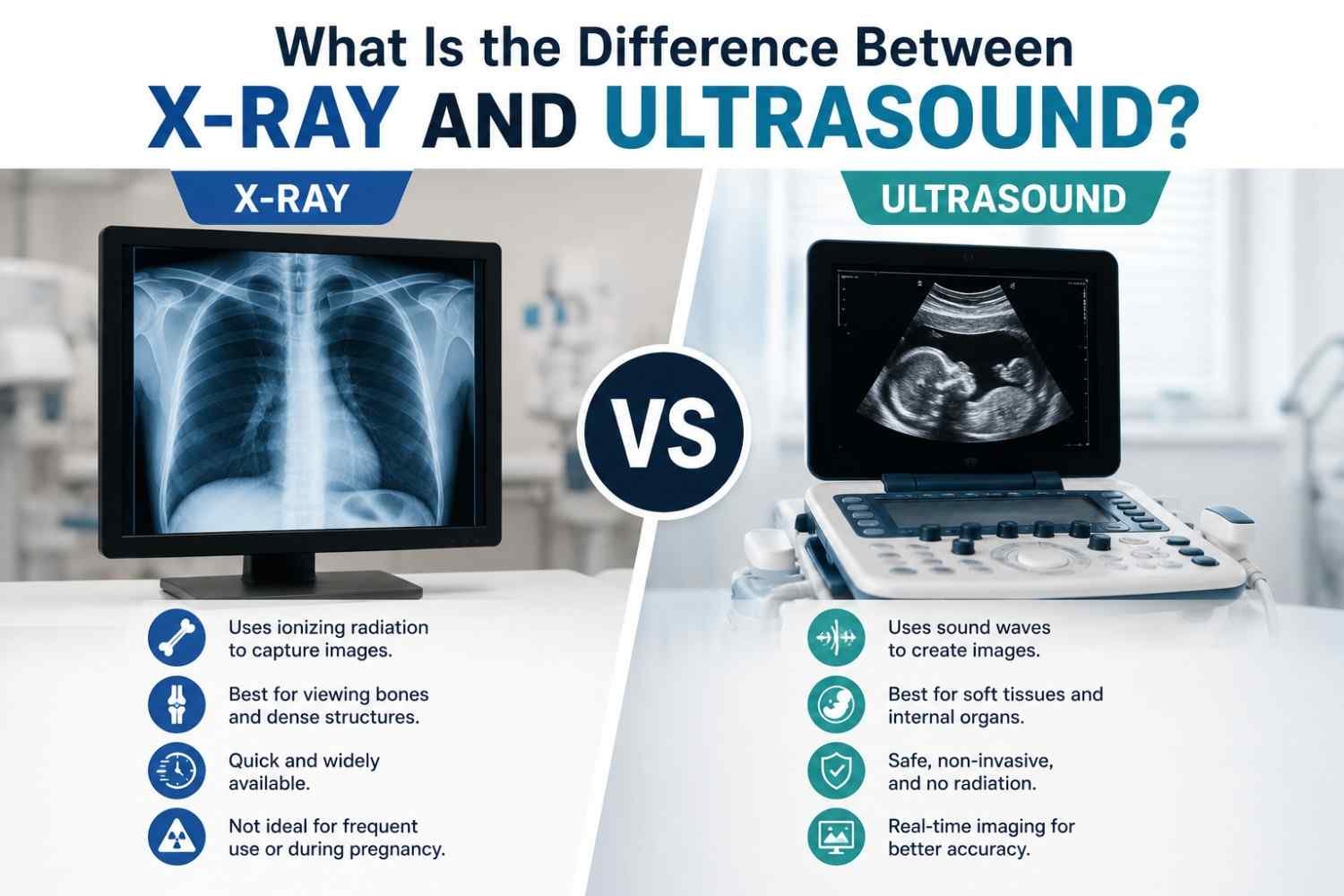
What Is the Difference Between X-Ray and Ultrasound?
OnePLUS Ultrasound Lab2026-07-16T12:52:50+00:00When your doctor recommends a diagnostic imaging test, it’s natural to wonder why a particular scan has been suggested. Many people often ask whether they need an X-ray or an ultrasound and if one is better than the other. The truth is that both imaging tests are valuable, but they serve different purposes. Understanding the difference between X-ray and ultrasound can help you feel more informed and confident about your healthcare journey.
While both tests help doctors diagnose medical conditions, they use completely different technologies. An X-ray is mainly used to examine bones and certain chest conditions, whereas an ultrasound is ideal for viewing soft tissues, internal organs, and monitoring pregnancy. Knowing the difference between X-ray and ultrasound ensures you understand why your doctor chooses one test over the other.
What Is the Difference Between X-Ray and Ultrasound?
The most significant difference between X-ray and ultrasound lies in how the images are created.
An X-ray uses a small amount of ionizing radiation to capture images of the inside of your body. Since bones absorb more radiation than soft tissues, they appear clearly on an X-ray image, making this test highly effective for detecting fractures and skeletal problems.
An ultrasound, on the other hand, uses high-frequency sound waves instead of radiation. A handheld device called a transducer sends sound waves into the body, and the returning echoes create real-time images of organs, muscles, blood vessels, and other soft tissues.
Because ultrasound does not involve radiation, it is considered one of the safest imaging techniques, especially during pregnancy and for children.
X-Ray vs Ultrasound: How Do They Compare?
When comparing X-Ray vs Ultrasound, it’s important to remember that neither test replaces the other. Each has its own strengths depending on the health condition being evaluated.
X-Ray Is Best For:
- Bone fractures and broken bones
- Joint dislocations
- Arthritis diagnosis
- Chest infections like pneumonia
- Dental examinations
- Detecting certain lung conditions
X-rays are quick, widely available, and often completed within a few minutes, making them an excellent choice during emergencies.
Ultrasound Is Best For:
- Pregnancy monitoring
- Liver, kidney, and gallbladder examination
- Thyroid evaluation
- Pelvic scans
- Muscle and tendon injuries
- Blood flow assessment using Doppler ultrasound
Unlike X-rays, ultrasound provides real-time images, allowing doctors to observe movement and blood circulation during the examination.
Difference Between Ultrasound Scan and X-Ray
Understanding the Difference Between Ultrasound Scan and X-Ray becomes easier when comparing their features.
Feature | X-Ray | Ultrasound |
Technology | Uses radiation | Uses sound waves |
Radiation | Yes | No |
Best For | Bones and chest | Soft tissues and organs |
Pregnancy | Limited use | Safe and commonly recommended |
Image Type | Static image | Real-time imaging |
Scan Time | 5–10 minutes | 15–30 minutes |
This simple comparison clearly explains the difference between X-ray and ultrasound and why doctors choose different imaging methods for different health concerns.
Ultrasound Imaging vs X-Ray: Which One Is More Accurate?
Many people assume one test is more accurate than the other, but accuracy depends entirely on what needs to be examined.
When discussing Ultrasound Imaging vs X-Ray, an X-ray provides better images of hard structures like bones. If someone has suffered a fracture, a dislocated joint, or a chest injury, an X-ray is usually the first choice.
Ultrasound, however, is much better for evaluating soft tissues and internal organs. It is commonly used to examine the liver, kidneys, pancreas, thyroid, uterus, ovaries, and unborn baby during pregnancy. It also helps doctors assess muscles, tendons, and blood vessels in real time.
In simple words, both tests are accurate—they’re just designed for different medical purposes.
When to Choose X-Ray or Ultrasound
Patients often wonder when to Choose X-Ray or Ultrasound. The answer depends on your symptoms and what your doctor suspects.
An X-ray is usually recommended if you have:
- Bone pain after an injury
- Suspected fractures
- Chest pain or breathing problems
- Dental issues
- Arthritis or joint abnormalities
An ultrasound is generally recommended if you have:
- Abdominal pain
- Pregnancy-related check-ups
- Swelling in the neck or thyroid
- Kidney or gallbladder concerns
- Pelvic pain
- Soft tissue injuries
- Blood circulation problems
Understanding when to choose X-Ray or ultrasound helps patients appreciate why different imaging tests are used for different conditions, instead of assuming one is always better. It kind of depends, right, on what the doctors are looking for.
Which is better X-ray or Ultrasound?
A common question patients ask is, Which is better, X-ray or Ultrasound?
The answer isn’t straightforward because the “better” test depends on the medical condition.
If your doctor needs to examine bones, joints, or the lungs, an X-ray is often the most suitable option. However, if the focus is on soft tissues, internal organs, pregnancy, or blood vessels, ultrasound provides more useful information.
Another important advantage of ultrasound is that it does not expose patients to radiation, making it a preferred option for pregnant women and situations where repeated imaging is required.
Rather than asking which is better, X-ray or Ultrasound, it’s more helpful to ask which test is right for your specific symptoms.
Benefits of X-Ray
X-rays continue to be one of the most commonly used diagnostic tools because they offer several advantages.
Some key benefits include:
- Fast examination
- Excellent for diagnosing fractures
- Helpful in emergency situations
- Affordable and widely available
- Clear images of bones and chest structures
Benefits of Ultrasound
Ultrasound is equally valuable and offers several unique benefits.
Some of its advantages include:
- No radiation exposure
- Safe for pregnancy
- Real-time imaging
- Excellent visualization of soft tissues
- Can evaluate blood flow using Doppler technology
- Suitable for repeated follow-up scans
These benefits further highlight the difference between x-ray and ultrasound and explain why both tests remain essential in modern healthcare.
Choosing a Reliable Diagnostic Centre Matters
Even the most advanced imaging technology delivers the best results only when operated by experienced professionals using high-quality equipment.
In case you need an advanced pregnancy or fetal scan, opting for the best 5D Ultrasound machine test in Delhi will offer you clear imaging that leads to accurate diagnoses. On the other hand, opting for the 3D Ultrasound Lab in Delhi will offer you advanced ultrasound equipment and expert radiologists.
Selecting an accredited diagnostic centre not only improves image quality but also helps doctors make timely and accurate treatment decisions.
Conclusion
Differentiating between the use of X-rays and ultrasounds can help patients be aware of the best choice for their health needs. While X-rays and ultrasounds both play vital roles in diagnosis, they serve different purposes altogether. X-rays are very helpful when assessing bone and joint problems as well as chest ailments. Ultrasounds are better suited for examining soft tissues and pregnancies.
If you’re still not quite sure about how an X-ray and an ultrasound differ, don’t be shy; talk with your doctor or even a radiologist. They’ll usually point you toward the most fitting imaging test, based on what you’re feeling, your symptoms, your medical history, and also what diagnostic need you actually have. Choosing the right scan at the right moment can support a more accurate diagnosis and help you begin the most effective treatment sooner, instead of later.