Testicular Pain: Why Your Doctor May Suggest an Ultrasound
OnePLUS Ultrasound Lab2026-07-18T07:21:36+00:00Testicular pain isn’t something most people like to talk about, but it’s also not a symptom you should ignore. Whether it’s a dull ache, sudden sharp pain, or discomfort that comes and goes, your body is trying to tell you something. While the cause may be as simple as a minor injury, it can also point to an infection, reduced blood flow, or another condition that needs medical attention. That’s why doctors often recommend a Testicular Pain Ultrasound to understand what’s happening beneath the surface.
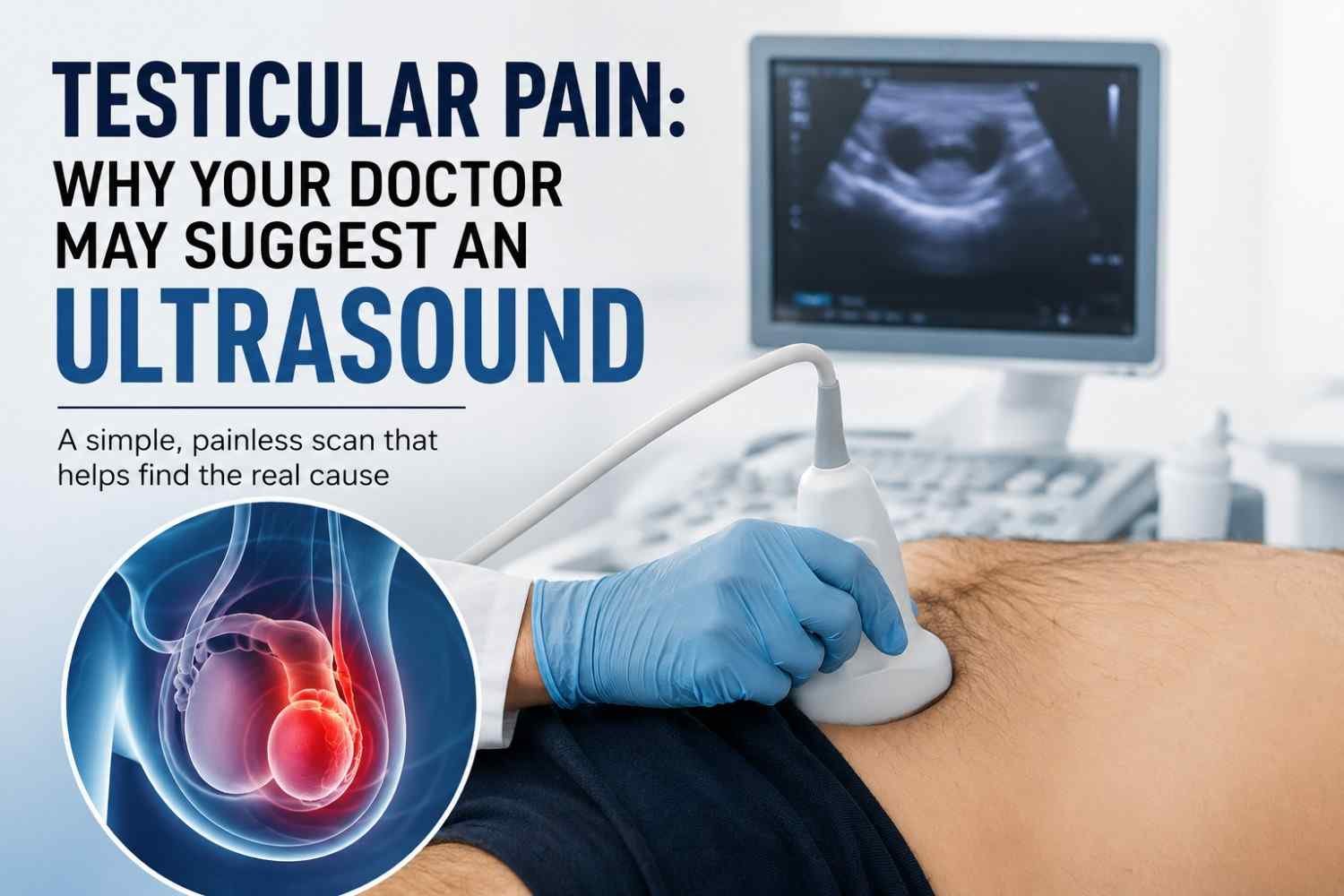
A Testicular Pain Ultrasound is a quick, safe, and painless scan that helps doctors see the testicles and surrounding tissues in detail. It doesn’t use radiation, requires no surgery, and usually takes less than 30 minutes. Most importantly, it helps identify the exact cause of pain so the right treatment can begin without unnecessary delays.
What Is a Testicular Pain Ultrasound?
A Testicular Pain Ultrasound is an imaging test that uses sound waves to produce clear pictures of the testicles and scrotum. Also called a Testicular Ultrasound, it allows doctors to examine the internal structures without making any cuts or exposing you to radiation.
This scan is commonly recommended when someone feels pain, swelling, a knot, or any unusual change in the scrotum. Since many problems share the same kind of symptoms, an ultrasound gives useful insight that a simple physical check can not. It sort of helps sort out what’s going on in a clearer way, because otherwise it can be hard to tell by looking.
Common Testicular Pain Causes
There are many Testicular Pain Causes, and not all of them are serious. However, because some conditions require immediate treatment, it’s important to find the exact reason rather than guessing.
Some of the most common causes include:
- Testicular torsion
- Epididymitis (infection)
- Orchitis (inflammation)
- Hydrocele
- Varicocele
- Testicular cysts
- Sports injuries
- Inguinal hernia
- Kidney stone pain that spreads to the groin
- In rare cases, testicular tumors
A Testicular Pain Ultrasound helps doctors rule out serious conditions while confirming the actual source of discomfort.
When to Get a Testicular Ultrasound
Knowing when to get a Testicular Ultrasound can help prevent complications. You should consult a doctor if you notice:
- Sudden or severe pain
- Swelling or redness
- A lump in the testicle
- Pain that lasts for several hours
- Fever along with testicular pain
- Pain after an injury
- A feeling of heaviness in the scrotum
If the discomfort shows up all at once and then becomes severe, please seek emergency medical care right away. Things like testicular torsion need prompt attention, because delay can lead to lasting, permanent harm.
How a Scrotal Ultrasound Helps
The Scrotal Ultrasound provides detailed images of the scrotum and testicles as well as the surrounding tissues. The procedure enables the doctor to detect conditions that are not necessarily detectable by physical examination or may have been missed by the physical examination.
The scan can detect:
- Infections and inflammation
- Fluid collection
- Varicocele and hydrocele
- Testicular cysts
- Injuries
- Abnormal masses
- Blood flow abnormalities
Since it brings real-time images, a Scrotal Ultrasound plays an important part in helping with an accurate diagnosis, and it also gives doctors more immediate insight.
Why Doppler Ultrasound for Testicular Pain Is Important
Sometimes your doctor may recommend a Doppler Ultrasound for Testicular Pain in addition to a routine ultrasound. This special scan checks how blood flows through the testicles.
A Doppler Ultrasound for Testicular Pain is often quite helpful for spotting problems like testicular torsion, where the blood flow gets reduced. It can also show infections that lead to a higher blood perfusion, so things look different on the screen. By checking circulation, doctors can act fast and then decide if medication is enough or if emergency care is required.
What Happens During the Scan?
The procedure is simple and usually takes about 20–30 minutes.
During the scan:
- You’ll lie comfortably on an examination table.
- A clear gel will be applied to the scrotal area.
- A handheld probe is gently moved over the skin.
- Images are captured from different angles.
- If necessary, Doppler imaging is performed to evaluate blood circulation.
A Testicular Ultrasound is painless, requires no recovery time, and you can return to your normal routine immediately after the test.
Benefits of a Testicular Pain Ultrasound
Doctors recommend a Testicular Pain Ultrasound because it offers several advantages:
- Safe and radiation-free
- Non-invasive and painless
- Quick and reliable
- Helps detect infections and injuries
- Evaluates blood flow
- Identifies lumps, cysts, and swelling
- Supports early diagnosis
- Guides appropriate treatment
Early diagnosis often leads to faster treatment and better outcomes.
Choosing the Right Diagnostic Centre
Getting your scan done at a trusted diagnostic centre ensures accurate imaging and reliable reporting. Experienced radiologists and modern ultrasound technology can make a significant difference in identifying the exact cause of testicular pain.
If you’re looking for advanced pregnancy imaging services, you can also explore a 5D Ultrasound machine test in Delhi for detailed fetal scans. Similarly, patients seeking high-quality prenatal imaging may choose a trusted 3D Ultrasound Lab in Delhi equipped with advanced ultrasound technology.
Conclusion
Testicular pain should never be ignored, even if it seems mild at first. While some cases improve with simple treatment, others require immediate medical attention. A Testicular Pain Ultrasound is one of the safest and most effective ways to find the cause of pain, swelling, or discomfort without surgery or radiation.
Don’t ignore any persistent pain or strange changes and seek medical guidance as soon as possible. An Ultrasound for Testicular Pain will assist the doctor in diagnosing your condition correctly and prescribing appropriate treatment.